Who was Tycho brahe what were tycho brahe contributions to astronomy
Tycho Brahe Biography
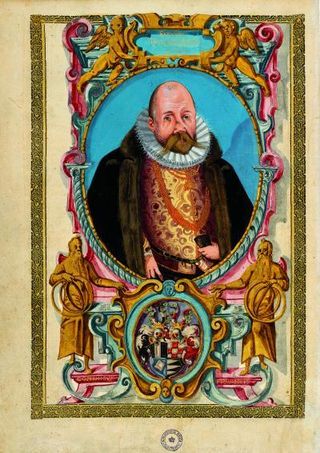
Danish astronomer Tycho Brahe fabricated the about accurate celestial observations of his time and challenged the prevailing belief in how the universe was organized. And while nearly people may think of scientists as stodgy bookish types, Brahe'south flamboyant lifestyle and ignominious expiry would take made some of today's wild celebrities look similar choirboys.
A colorful life
Born in Denmark in 1546, Brahe's parents were members of nobility. He was raised past his wealthy uncle, and attended universities in Copenhagen and Leipzig. Though his family badgered him to report police force, Brahe chose instead to pursue astronomy.
In 1566, 20-year-old Brahe fought a fellow student in a duel over who was the better mathematician. As a result, he lost a big clamper of his olfactory organ. For the residuum of his life, he donned a metal prosthetic to cover the disfigurement.
A mysterious expiry
Brahe died in 1601 at the age of 54. While attending a feast, societal customs did non permit him to excuse himself before his host. Brahe had drunkard excessively, but refused to get out to use the bathroom. Information technology is thought that this caused his bladder to burst and led to his subsequent expiry.
However, scientists who opened Brahe's grave in 1901 to mark the 300th anniversary of his death claimed to find mercury in his remains, fueling rumors that the astronomer was poisoned. Some even defendant a jealous Johannes Kepler of the crime.
Brahe'due south body was exhumed again in 2010. Tests on his bones and beard hairs showed that mercury concentrations in his torso were not high enough to accept killed him.
"In fact, chemic analyses of the bones indicate that Tycho Brahe was not exposed to an abnormally high mercury load in the last five to ten years of his life," researcher Kaare Lund Rasmussen, an acquaintance professor of chemistry at the Academy of Southern Kingdom of denmark who analyzed mercury levels in Brahe's beard and bones, said in a argument.
Yet, farther research revealed that the astronomer was exposed to high levels of golden in his lifetime. "We constitute traces of gold in Tycho Brahe's hair, and we can constitute that he was exposed to aureate while these hairs were still on his body," Rasmussen said in a 2016 statement.
"Information technology may have been the cutlery and plates of gold, or maybe the wine he drank independent aureate leaf. It's besides possible that he concocted and consumed elixirs containing gold, or that he worked with abracadabra,"
Researchers besides found that greenish stains around the nasal areas of Brahe'due south corpse independent traces of copper and zinc, indicating that his simulated nose was fabricated of contumely and not silverish or gold, every bit many had believed.
"When we exhumed the torso in 2010, nosotros took a small bone sample from the nose so that we could examine its chemic composition," project leader Jens Vellev, an archeologist at Aarhus University in Kingdom of denmark, said the same statement. "Surprisingly, our analyses revealed that the prosthesis was non made of precious metals, equally was previously supposed ... So Tycho Brahe'due south famous 'silver nose' wasn't fabricated of silvery after all."
Tycho Brahe pronunciation
When Brahe was built-in, his Danish name was Tyge Otteson Brahe. However, he adopted a Latinized course, Tycho Brahe, when he was nigh 15 years old. In that location is non much consensus about how the name is pronounced in English. Some say his first name is "tee-ko"; others say "tie-ko." His last name is pronounced either "brah," "bra-hay" or "bra-hee." He is sometimes referred to only by his beginning name, as in Tycho Crater on the moon, the Tycho Deep Space capsule and Tycho's Supernova Remnant.
A precise view of the heavens
Despite his colorful life and death, Brahe contributed a not bad bargain to the field of astronomy. At the fourth dimension, astronomers held to the idea that the heavens were equanimous of divide individual spheres, with everything revolving around the World. [Come across also our overview of Famous Astronomers and neat scientists from many fields who have contributed to the rich history of discoveries in astronomy.]
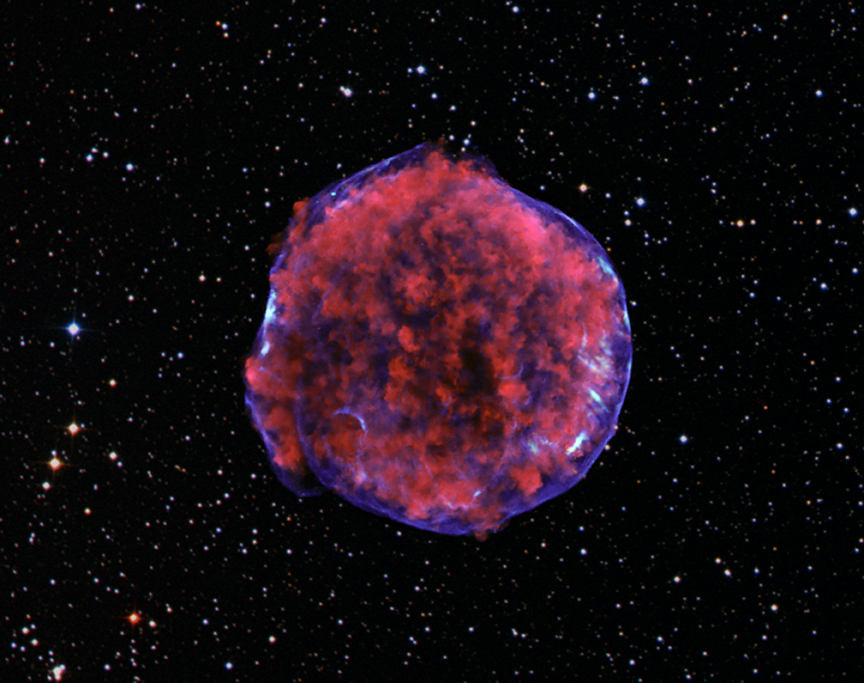
In 1572, Brahe observed a supernova in the constellation of Cassiopeia. Brighter than Venus, the new star remained visible for a year and a one-half. In 1577, he observed a comet. Current theory taught that both were disturbances in the atmosphere. All the same, Brahe's precise measurements revealed differently. He proved that the supernova never changed with regard to the surrounding stars, and that the comet orbited beyond the path of the moon, contradicting the idea that the heavens never changed.
In 1575, King Frederick Two sought to go on the now-famous Brahe in Denmark by offering him his own isle and fiscal support to study astronomy. There, Brahe built an enormous observatory, where he kept meticulous observations of the heavens. While almost astronomers simply focused on observing heavenly bodies at specific, unusual points in their orbits, Brahe intently tracked them in their entire visible orbit across the sky, creating the virtually precise observations made at the time. Some of his measurements were accurate to half an arc minute, which is especially admirable given that they were all made earlier the advent of the telescope.
Although Brahe's observations revealed the flaws of the current system, he did not embrace Nicolaus Copernicus' newly proposed sun-centered model. Instead, he offered a model that combined the two, setting the moon and sun in orbit around the Earth even every bit the other v known planets circled the sun. The model became popular amidst those who wanted to leave the older view behind but weren't ready to embrace the idea of the sunday at the heart of the solar system.
According to Rice's University'due south Galileo Project, "Tycho Brahe'southward contributions to astronomy were enormous." In addition to his observations, he also designed and built instruments, periodically calibrating them and checking their accuracy. "He thus revolutionized astronomical instrumentation."
How Kepler got his kickoff
Brahe'southward precise measurements laid the foundation for a new agreement of the motion of the planets. German astronomer Johannes Kepler contacted him at the end of the 16th century in an effort to obtain copies of the Danish astronomer'southward inquiry. Brahe countered with a suggestion that Kepler could work equally his assistant, helping him to compile his data.
However, Brahe proved more tightfisted than Kepler had predictable and refused to share his measurements of the planets and their orbits. Instead, he suggested Kepler work on solving the Mars dilemma that plagued astronomers.
Because of its orbit, Mars appears to occasionally move backwards across the sky, causing many astronomers to propose epicycles, tiny circles inside their orbit. Even Copernicus' proffer that the planets orbited the sun in circles could non business relationship for the red planet'southward foreign motion.
Kepler, using Brahe'due south detailed observations, realized that the planets moved effectually the sun not in circles but in stretched out circles known as ellipses. However, the problem took him almost a decade to solve, and Kepler didn't publish it until well after Brahe'southward death. Although Brahe's family intended to reap as much financial gain equally possible from Brahe's observations, Kepler, by his own admission, less-than-ethically caused them after Tycho died.
Follow Nola Taylor Redd at @NolaTRedd, Facebook, or Google+. Follow us at @Spacedotcom, Facebook or Google+.
Additional resources
- University of St. Andrews: Tycho Brahe
- Smithsonian: Astronomer and Alchemist Tycho Brahe Died Total of Aureate
- Wolfram Research: Tycho Brahe
Join our Space Forums to keep talking space on the latest missions, night sky and more! And if you have a news tip, correction or comment, let u.s.a. know at: community@space.com.
Nola Taylor Tillman is a contributing writer for Space.com. She loves all things infinite and astronomy-related, and enjoys the opportunity to learn more. She has a Bachelor'due south degree in English and Astrophysics from Agnes Scott higher and served every bit an intern at Heaven & Telescope magazine. In her free time, she homeschools her iv children. Follow her on Twitter at @NolaTRedd
Source: https://www.space.com/19623-tycho-brahe-biography.html
0 Response to "Who was Tycho brahe what were tycho brahe contributions to astronomy"
Enviar um comentário