California Center for Digital Arts Who Is the Owner
Grand. T. Dremer studied graphic design at Muskegon Customs College and has been using Adobe Photoshop for more than a decade.
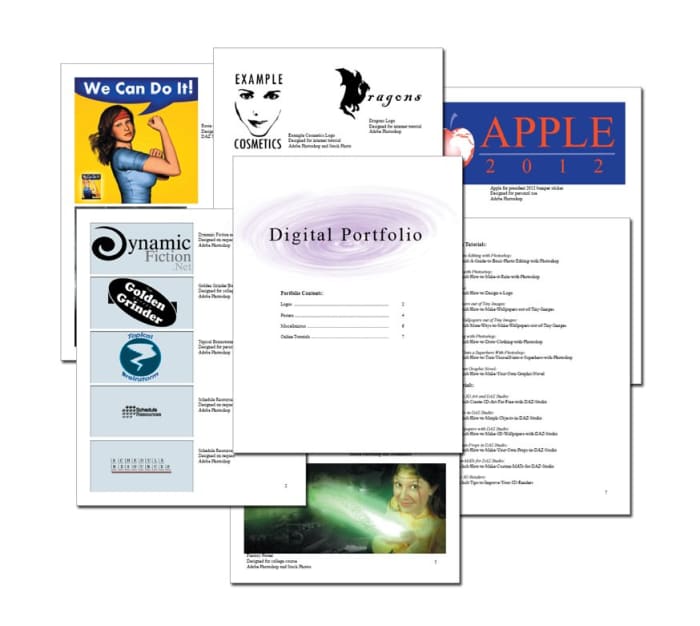
Graphic Design is one of my passions, merely I didn't seriously consider applying for any jobs in the field until merely recently. Every bit I examined many of the openings I noticed that most, if not all, graphic design positions request that a portfolio exist submitted along with a resume and/or cover letter. I've made art portfolios in the by, but upwards until this point, my thought of a portfolio has been one of ii things; either it'south a fancy leather case with physical sheets of newspaper within of information technology (with the artwork on those sheets) or it is a website with links to uploaded works. In that location were a couple of bug I had with each of these methods. The first is that I'm a graphic designer, not a painter or an illustrator. I do nigh, if not all, of my artwork on the computer with Photoshop. I understand that an creative person of whatever kind should be well rounded, and I took my off-white share of traditional art classes in higher, merely that didn't hateful I had any illustrated work that I wanted to put in a portfolio. For that reason, the leather case seemed lightheaded as it would have consisted merely of printed works from a figurer. The second option; a website, while a great avenue for any artist looking to go into the field, didn't appeal to me. I design as a hobby, and the thought of paying for the upkeep of a website I might rarely, or never, use seemed silly. Then when I observed the task postings I began to wonder what I could come up with as an culling; something that would showcase my digital piece of work and could be fastened to an e-mail. The following is what I came up with.
Disclaimer: All of the methods described in this article were thought up past me and aren't necessarily a representation of the standards for professional person portfolios. The purpose of this article is to give another choice to people who, like me, would like to showcase their artwork in a convenient, digital form.
Step 1: Compile Your Piece of work
The first thing you desire to do is get together every sliver of artwork you've created that yous want to correspond you. This could be anything from a sketch in a notebook to a movie poster you designed on your calculator. Pick the things you are near proud of or that y'all think turned out every bit an impressive terminal product. Information technology helps to make a list of these so you lot tin keep track of which ones y'all have and haven't added to the portfolio yet. You lot could as well brand a folder on your computer defended to works that will eventually go into your portfolio. A folder would also help if yous are scanning drawings/paintings into your figurer.
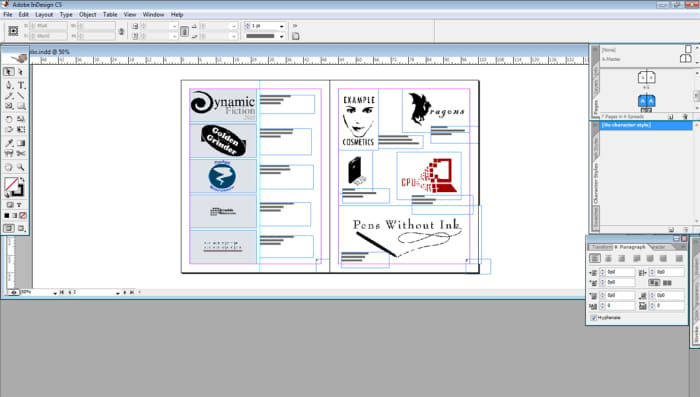
This is an example of what your portfolio volition await similar in page making programs. This one is Adobe InDesign and I'm showing two examples of how you lot could layout your folio.
Stride 2: Choose your portfolio type
For my portfolio I chose the PDF format. I did this because PDF has the capability to be multiple pages with text and picture at a decent file size. I did find, however, that when saving a document every bit a PDF, the picture show colour doesn't ever catechumen the way you want it to. For this reason, you may have to brand adjustments to the original picture depending on whether or not you call back the color changes are detrimental to your work. Also notation that you will need the full version of Adobe Acrobat in order to brand a PDF document. I believe in that location might be some free conversion tools floating around on the cyberspace, but I haven't come across a reliable i, so I can't recommend any. Once Adobe Acrobat is installed on your computer, y'all tin convert a number of unlike documents into the PDF format, including Microsoft discussion, Adobe InDesign (which is what I used), or QuarkXpress.
If yous don't have Adobe Acrobat or whatsoever page design software, and yous can't beget to buy them (they are pretty expensive if you're not a higher student) and so another choice available to you would exist the zip folder. In this scenario, all of your images would exist saved in an prototype format (jpeg would be all-time) and then zipped to a common folder that would serve as your portfolio. (If y'all made a binder for all of your images and then you're already ahead of the game.)
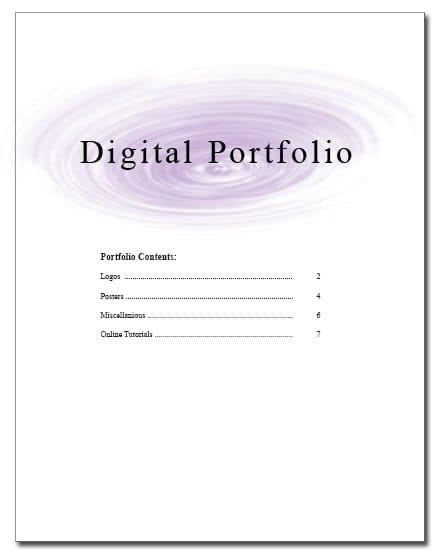
Organize your images and give them a table of contents. The terminal affair yous desire to do is confuse the employer.
Step 3: Organizing your work
One time y'all accept all of your work compiled, it'due south a good idea to organize it into some sense of order. For example, you could group all of your logos together or organize all your posters on the same page. The reason that yous will desire to practice this is so that you tin can create a table of contents and any prospective employer can unmarried out projects that are relevant to their specific company. For example, a visitor that deals simply with making pamphlets might not care about that motion picture you drew of shaded eggs. That doesn't mean yous can't include these things, it just ways you should categorize it every bit a drawing so that the employer can notice what they're looking for much easier.
If you lot're using Microsoft Word, Adobe InDesign or QuarkXpress, a tabular array of contents is adequately like shooting fish in a barrel. Include each category of art (logos, illustrations, posters, etc.) and the page number of where each one begins. If you're using the Cipher folder method, try to include a text file with your pictures that identifies them. There won't be page numbers, by you lot can listing each work included, likewise as a brief description so the employer will know if they desire to look at it or non. It might also be helpful to label your files in the post-obit way: Logo1, Logo2, Illustration1, Illustration2. This is to ensure the least amount of confusion when viewing your portfolio.
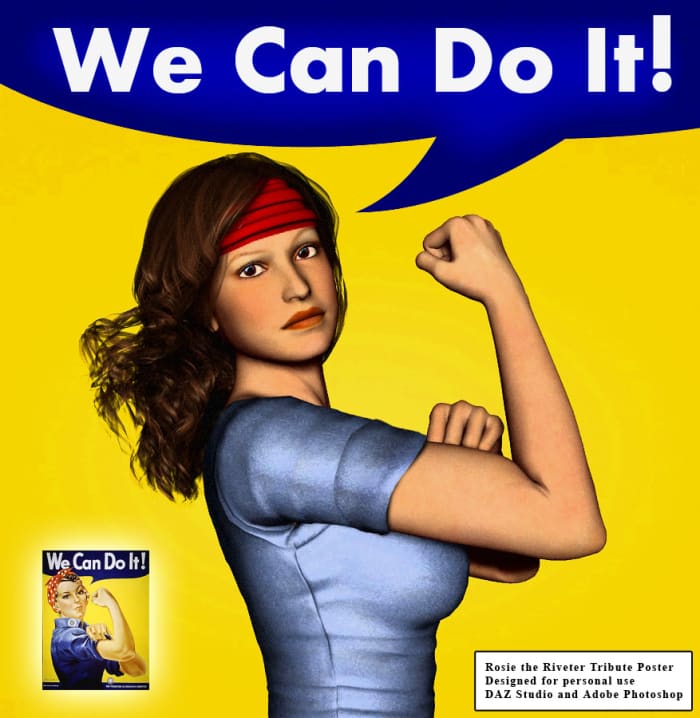
This is an example of how you lot could label your pictures if y'all aren't using a page making program. Notice the white box in the lower right and the data information technology contains.
Pace 4: Labeling your work
Coil to Continue
Read More From Toughnickel
To continue things simple and concise, I use the following format for labeling images when I created my portfolio:
Title of piece
Reason for creating it
Materials used to create it
So, for example, I labeled one of my logos in the post-obit manner:
Example Cosmetics Logo
Designed for net tutorial
Adobe Photoshop
In three uncomplicated lines this tells the employer what the slice is, why you lot made it, and what you fabricated it with. This information can exist written side by side to the image or on the prototype (on the epitome might be the all-time choice for a zip portfolio equally long as it doesn't obscure the artwork). It is also a good idea to list whatever accolades any given image might accept. For case, if you entered your piece into a competition and received an honorable mention, yous should identify that on the prototype.
Stride five: Miscellaneous and Finalizing
Earlier you finish your portfolio, consider adding any other information that might be relevant. If you've had an fine art-related task or accolade that is unrelated to the artwork in the portfolio, then make a point to write those down besides. In my case, I provided the titles of, and links to, my graphic design tutorials hither on HubPages. Not only does it display more of my graphic pattern piece of work, it also demonstrates my cognition of the field.
In one case you have all the artwork, the tabular array of contents, and miscellaneous items compiled together information technology's time to finalize information technology. If y'all created it in Microsoft word, you might be able to exit it in that format (though images tend to load slowly in discussion). If not, and so convert it to a PDF using the file menu selection. The same can be accomplished in InDesign by selecting "export" from the file menu. If y'all are using the zippo folder method, only right click on your portfolio folder and click on "send to" followed by "Compressed folder".
Throughout all of this, keep in mind file size. If the images you've included are enormous, then you won't be able to attach your portfolio to whatsoever emails (email providers usually have a size limit on attachments). If you find that yours is too big, effort shrinking each individual image, or reducing the amount of images in the portfolio.
You're washed! Congratulations, yous have a digital art portfolio; one that doesn't crave payment to budget and can be submitted digitally. Hopefully information technology volition help go you on your way to a promising Graphic Pattern career.
Boosted Tips
- If you have drawings/paintings that y'all desire to include, only don't have a scanner, call your local library. Often times public reckoner labs will have a scanner available for utilise. Just remember to bring your wink drive.
- If you call up your portfolio is defective content, don't be afraid to create something new. Draw a new movie, or design a mock-upward poster. It'south quicker to utilize things yous've already created, simply a portfolio is all near showing off your artistic abilities, then don't exist afraid to become that extra mile.
- When organizing your images in a page making plan (like Adobe InDesign or QuarkXpress) always work towards clarity. Your format could be a clean list of pictures, or a wacky fun screw pattern, just if the employer can't follow it, then it isn't serving its purpose. (See second image for some examples of layouts.)
This commodity is accurate and truthful to the best of the author's cognition. Content is for advisory or amusement purposes only and does not substitute for personal counsel or professional advice in business, financial, legal, or technical matters.
mpofu njabulo on June 26, 2019:
a very informative guide to digital portfolios.
Lilly on July xxx, 2018:
Thankyou and then much for this - it was very thorough and extremely helpful
Joel Jay Arts on December 15, 2017:
This is really overnice and it has helped me.. What a wonderful idea
sana on July 26, 2017:
A helpful information
M. T. Dremer (author) from United States on November 05, 2013:
Hugo Furst - Give thanks you for the compliment. When virtually applications have identify online, I tried to figure out a way to make the portfolio digital and easy to read. It's a fun method to play around with.
Hugo Furst from Australia on November 04, 2013:
What an interesting method you have! Thanks for sharing it, pal :) Looking forward to reading more of your stuff. Voted up!
M. T. Dremer (author) from United States on March 13, 2013:
Vector design - Thank you for the compliment and the comment!
Saim from California on March 12, 2013:
Very informative Hub. I really like your thought. Y'all discuss some good points in this hub.thanks for sharing.
M. T. Dremer (author) from United States on May 04, 2012:
Randy M. - You're welcome! It's very handy to have a portfolio that can be shot off in an email. Good luck, and thanks for the annotate!
Randy McLaughlin from Liberia, Costa Rica on May 03, 2012:
I am now motivated to make my ain digital fine art portfolio. Thank you!
asigurare from Bucharest, Romania on August 17, 2011:
Thank you for this commodity. Now I want to use what I accept learned and to make my own digital portfolio.
1000. T. Dremer (author) from United States on June 22, 2011:
paul - You lot're welcome. When I first wanted to create a digital portfolio I had no idea which direction to go in, so I'm glad that I could help!
paul on June 22, 2011:
Thank yous for this, its expert to accept some pointers.
G. T. Dremer (author) from U.s.a. on April 05, 2011:
maria.rose - Cheers for the compliment! When I first started researching how to make a digital art portfolio, none of the methods actually matched up with what I wanted to do. So I'grand very glad I conveyed my methods clearly. Give thanks you for commenting!
maria.rose from Florida on April 04, 2011:
Splendid, clear. And accurate information. You release the information at a very good rhythm and speed and are perfectly understandable .thanks a lot for sharing this.
Source: https://toughnickel.com/finding-job/How-to-Create-a-Digital-Art-Portfolio
0 Response to "California Center for Digital Arts Who Is the Owner"
Enviar um comentário