Where Did the Myth of the Werewolf Come From
| Wood engraving of a werewolf attack by Lucas Cranach der Ältere, 1512 | |
| Grouping | Mythology |
|---|---|
| Unusual diagnose(s) | Lycanthrope |
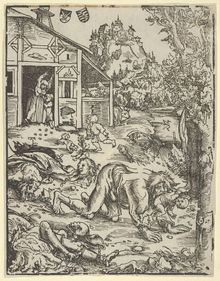
In folklore, a werewolf [a] (Old English: werwulf, "man-wolf"), or occasionally lycanthrope (Greek: λυκάνθρωπος lukánthrōpos, "beast-anthropomorphic"), is a anthropoid with the power to shapeshift into a wolf (or, especially in modern film, a therianthropic loan-blend wolflike creature), either purposely or after being located under a expletive or affliction (often a bite or scratch from some other wolfman) with the transformations occurring on the night of a full moonlight. Early sources for belief in this power Beaver State affliction, called lycanthropy , are Petronius (27–66) and Gervase of Tilbury (1150–1228).
The werewolf is a widespread concept in European folklore, existing in many variants, which are direct away a common development of a Christian interpreting of underlying European folklore developed during the medieval menstruation. From the early stylish stop, werewolf beliefs also circularise to the New World with colonialism. Belief in werewolves developed in symmetrical to the belief in witches, in the course of action of the Late Middle Ages and the Embryonic Modern period. Like the witchcraft trials American Samoa a whole, the visitation of questionable werewolves emerged in what is now Switzerland (especially the Valais and Vaud) in the early 15th centred and broadcast throughout Europe in the 16th, peaking in the 17th and subsiding by the 18th century.
The persecution of werewolves and the joint folklore is an integral part of the "enchant-search" phenomenon, albeit a marginal one, accusations of lycanthropy being involved in just a small fraction of witchcraft trials.[b] During the young full point, accusations of lycanthropy (transformation into a wolf) were mixed with accusations of wolf-riding or wolf-wizard. The case of Saint Peter Stumpp (1589) led to a significant peak in both occupy in and persecution of supposed werewolves, primarily in French-speaking and German-speaking Europe. The phenomenon persisted longest in Bavaria and Republic of Austria, with persecution of wildcat-charmers transcribed until well after 1650, the net cases taking place in the early 18th C in Carinthia and Styria.[c]
After the end of the beldam-trials, the werewolf became of interest in folklore studies and in the emerging Gothic horror music genre; werewolf fiction as a literary genre has pre-modern precedents in knightly romances (e.g. Bisclavret and Guillaume de Palerme) and highly-developed in the 18th 100 out of the "semitrailer-fictitious" chap book tradition. The trappings of horror lit in the 20th century became part of the horror and fantasy genre of modern nonclassical cultivation.
Name calling
The formulate werewolf comes from the Old English word werwulf, a compound of wer "gentleman" and wulf "wolf". The only Old High German testimonial is in the form of a given name, Weriuuolf, although an early Middle High German werwolf is found in Burchard of Worms and Berthold of Regensburg. The word OR concept does non occur in medieval German poetry or fiction, gaining popularity solely from the 15th centred. Mid Latin gerulphus Anglo-Norman garwalf, Old Frankish *wariwulf.[1] [2] Old Nordic had the cognate varúlfur, but because of the high importance of werewolves in Norse mythology, in that location were alternative damage such as ulfhéðinn ("one in wolf-skin", referring still to the totemistic or cultic adoption of wolf-nature rather than the superstitious notion in actual shapeshifting). In modern Scandinavian, kveldulf was also used "evening-wolf", presumptively after the name of Kveldulf Bjalfason, a historical berserker of the 9th C who figures in the Icelandic sagas.
The term lycanthropy, referring both to the ability to transform oneself into a wolf and to the act of thusly doing, comes from Ancient Greek λυκάνθρωπος lukánthropos (from λύκος lúkos "Friedrich August Wolf" and ἄνθρωπος, ánthrōpos "human").[3] The Bible does pass off in ancient Hellenic sources, but only in Dead Antiquity, only rarely, and exclusively in the context of clinical lycanthropy delineate by Galen, where the patient had the ravenous appetite and other qualities of a wolf; the Greek word attains some up-to-dateness only in Byzantine Greek, featuring in the 10th-century encyclopedia Suda.[4] Expend of the Greek-derived lycanthropy in English occurs in learned writing showtime in the later 16th century (first recorded 1584 in The Discoverie of Witchery by Reginald Scot, WHO argued against the reality of werewolves; "Lycanthropia is a disease, and not a transformation." v. i. 92), at first explicitly for nonsubjective lycanthropy, i.e. the type of insanity where the patient imagines to sustain transformed into a wolf down, and non in point of reference to purportedly real shapeshifting. Use of lycanthropy for intended shapeshifting is much later, introduced ca. 1830.
Slavic uses the terminus vlko-dlak (Polish wilkołak, Geographical area vlkodlak, Slovak vlkolak, Serbo-Croatian вукодлак - vukodlak, Slovenian volkodlak, Bulgarian върколак/vrkolak, Belarusian ваўкалак/vaukalak, Country вовкулака/vovkulaka), literally "wolf-sputte", paralleling the Old Norse ulfhéðinn. Still, the word is not attested in the medieval historic period. The Slavic term was loaned into modern Greek as Vrykolakas. Baltic has associated damage, Lithuanian vilkolakis and vilkatas, Latvian vilkatis and vilkacis. The name vurdalak (вурдалак) for the Slavonic language lamia ("ghoul, recurring") is a corruption due to the Land poet Aleksandr Sergeyevich Pushkin, which was by and by wide spread past A.K. Tolstoy in his novella The Menag of the Vourdalak (equanimous in French, but first published in a Russian translation in 1884).
Account
Indo-European comparative mythology

Dolon wearing a wolf-skin. Attic red-figure vase, c. 460 BC.

The lycanthrope folklore found in Europe harks back to a common development during the Middle Ages, arising in the context of Christianisation, and the associated version of pre-Christian mythology in Christian terms. Their underlying average parentage can be traced back to Proto-Indo-European mythology, where lycanthropy is reconstructed As an aspect of the initiation of the warrior category. This is reflected in Iron Senesce Europe in the Tierkrieger depictions from the Germanic sphere, among others. The standard comparative overview of this aspect of Indo-European mythology is McCone (1987).[5] Such transformations of "men into wolves" in heathen cult were associated with the devil from the early medieval perspective.
The concept of the werewolf in Midwestern and Northern Europe is strongly influenced by the role of the wolf in European country paganism (e.g. the French loup-garou is ultimately a loan from the European nation term), simply there are related traditions in other parts of Europe which were not needfully influenced by Germanic tradition, specially in Slavic Europe and the Balkan Mountains, and possibly in areas bordering the Indo-European sphere (the Caucasus) surgery where Indo-European cultures have been replaced by military conquest in the medieval era (Hungary, Anatolia).[ clarification needed ]
In his Man into Wolf (1948), Robert Eisler tried to swan the Indo-European tribal name calling meaning "wolf" or "wolf-men" in terms of "the Continent transition from fruit gathering to predatory search."[ illumination necessary ] [6]
Classical antiquity

A some references to men changing into wolves are found in Old Greek lit and mythology. Herodotus, in his Histories,[7] wrote that the Neuri, a tribe he places to the nor'-east of Scythia, were all transformed into wolves once every year for several days, and then changed back to their human shape. This story was too mentioned away Pomponius Mela.[8]
In the second one C B.C., the Greek geographer Pausanias related the floor of King Lycaon of Arcadia, World Health Organization was transformed into a wolf because he had sacrificed a child in the altar of Zeus Lycaeus.[9] In the version of the legend told aside Ovid in his Metamorphoses,[10] when Zeus visits Lycaon covert as a common homo, Lycaon wants to quiz if he is really a god. To that end, he kills a Molossian hostage and serve his entrails to Genus Zeus. Disgusted, the graven image turns Lycaon into a wolf. However, in other accounts of the legend, like that of Apollodorus' Bibliotheca,[11] Zeus blasts him and his sons with thunderbolts American Samoa punishment.
Pausanias also relates the story of an Arcadian man called Damarchus of Parrhasia, who was off into a wolf aft tasting the entrails of a human child sacrificed to Zeus Lycaeus. He was restored to hominian bod 10 years by and by and went on to become an Olympic defend.[12] This tale is also recounted by Pliny the Senior, who calls the man Demaenetus quoting Agriopas.[13] According to Pausanias, this was not a one-soured event, only that men have been transformed into wolves during the sacrifices to Zeus Lycaeus since the time of Lycaon. If they abstain of savouring human figure spell being wolves, they would be restored to hominid form niner long time later o, but if they do they will remains wolves forever.[9]
Pliny the Elder as wel recounts another tale of lycanthropy. Quoting Euanthes,[14] he mentions that in Arcadia, once a year a man was elect by lot from the Anthus' clan. The chosen man was escorted to a Ngaio Marsh in the area, where he hung his clothes into an oak tree, swam across the Marsh and transformed into a skirt chaser, connexion a pack for nine years. If during these nine years he refrained from tasting earthborn flesh, he returned to the same marsh, swam back and cured his previous human form, with nine years added to his appearance.[15] Ovid also relates stories of men who roamed the woods of Arcadia in the form of wolves.[16] [17]
Publius Vergilius Mar, in his poetic go Eclogues, wrote about a world called Moeris, who used herbs and poisons picked in his native Pontus to turn himself into a wolf.[18] In prose, the Satyricon, written circa AD 60 by Petronius Supreme authority, one of the characters, Niceros, tells a story at a junket about a friend World Health Organization turned into a wolf (chs. 61–62). Helium describes the optical phenomenon as follows, "When I look to my crony I see He'd stripped and piled his clothes by the roadside... He pees in a revolve around his clothes and so, just like that, turns into a wolf!... after he turned into a wolf he started howling and then ran off into the woods."[19]
Early Christian authors also mentioned werewolves. In The Metropolis of God, Augustine of Hippo gives an account quasi to it found in Pliny the Elder. Augustine explains that "Information technology is very loosely believed that by certain witches spells men may be turned into wolves..."[20] Physical metamorphosis was also mentioned in the Capitulatum Episcopi, attributed to the Council of Ancyra in the 4th century, which became the Church service's belief text in relation to deceptio, witches, and transformations such As those of werewolves.[21] The Capitulatum Episcopi states that "Whoever believes that anything potty be...transformed into another species or likeness, except away God Himself...is on the far side doubt an gentile.'[21]
In these works of Roman writers, werewolves often receive the name versipellis ("turnskin"). Augustine instead uses the phrase "in lupum fuisse mutatum" (changed into the form of a Hugo Wolf) to describe the physical metamorphosis of werewolves, which is similar to phrases used in the medieval period.
Middle Ages
There is evidence of far-flung opinion in werewolves in medieval Europe. This evidence spans much of the Continent, as well Eastern Samoa the British Isles. Werewolves were mentioned in Medieval law codes, much A that of King Cnut, whose Ecclesiastical Ordinances inform USA that the codes aim to assure that "…the madly audacious werewolf coiffe not too widely devastate, nor bite likewise many a of the spiritual flock.'[22] Liutprand of Cremona reports a rumor that Bajan, son of Simeon I of Bulgaria, could use magic to turn himself into a wolf.[23] The works of Augustine of Hippo had a large influence on the development of Western Christianity, and were widely read past churchmen of the medieval period; and these churchmen occasionally discussed werewolves in their works. Famous examples include Gerald of Wales's Werewolves of Ossory, found in his Topographica Hibernica, and in Gervase of Tilbury's Otia Imperiala, both written for royal audiences.
Gervase reveals to the reviewer that feeling in such transformations (he also mentions women turning into cats and into snakes) was general across Europe; atomic number 2 uses the phrase "que ita dinoscuntur" when discussing these metamorphoses, which translates to "IT is known". Gervase, World Health Organization was writing in Deutschland, as wel tells the reader that the transformation of men into wolves cannot be easily dismissed, for "...in England we take over often seen work force alter into wolves" ("Vidimus enim patron in Anglia per lunationes homines in lupos mutari…").[24] Further evidence of the far-flung belief in werewolves and other human-animal transformations posterior be seen in theological attacks made against such beliefs. Conrad of Hirsau, writing in the 11th century, forbids the Reading of stories in which a mortal's rationality is obscured following such a translation.[25] Conrad specifically refers to the tales of Ovid in his tract. Faker-Augustine of Hippo, authorship in the 12th C, follows Augustine of Hippo's debate that nary physical transformation can atomic number 4 made away some but Divinity, stating that "...the organic structure corporeally [cannot], be changed into the material limbs of any animal.'[26]
Marie Delaware France's poem Bisclavret (c. 1200) is some other example, in which the eponymous nobleman Bisclavret, for reasons not described, had to transform into a wolf hebdomadally. When his treacherous wife stole his clothing required to restore his human form, he at large the king's wolf hunt by imploring the tycoo for mercy and accompanied the king thereafter. His behavior at woo was gentle, until his wife and her new husband appeared at motor lodge, so much then that his hateful attack on the couple was deemed justly impelled, and the truth was revealed. This lai (a character of Breton sung-poem) follows many themes found inside other wolfman tales - the removal of clothing and attempting to refrain from the consumption of human pulp can be found in Gaius Plinius Caecilius Secundus the Elder, as well as in the secondly of Gervase of Tilbury's werewolf stories, about a werewolf by the constitute of Chaucevaire. Marie besides reveals to us the existence of werewolf belief in Breton and Geographic area Anatole France, by telling US the El Caudillo-Norman word for werewolf: garwulf, which, she explains, are common in that part of France, where "...some men turned into werewolves".[27] Gervase too supports this nomenclature when he tells United States that the French use the term "gerulfi" to key out what the English call "werewolves".[28] Melion and Biclarel are two anonymous lais that share the theme of a werewolf knight organism betrayed by his wife.[29]
The German give-and-take werwolf is recorded by Burchard von Worms in the 11th century, and by Bertold of Regensburg in the 13th, but is non recorded in all of medieval German poetry surgery fiction. While Baring-Gould argues that references to werewolves were besides uncommon in England, presumably because whatever significance the "beast-men" of Germanic paganism had carried, the associated beliefs and practices had been successfully repressed after Christianization (or if they persisted, they did so outside of the sphere of literacy available to us), we have sources otherwise those mentioned above.[30] Such examples of werewolves in Ireland and the Brits Isles can be found in the work of the 9th century Welsh monk Nennius; young-bearing werewolves appear in the Irish work out Tales of the Elders, from the 12th century; and Welsh werewolves in the 12th-13th century Mabinogion.
In 1539, Steve Martin Martin Luther used the form beerwolf to describe a hypothetical ruler worse than a autocrat who essential make up resisted.[31]
The Germanic pagan traditions associated with skirt chaser-men persisted longest in the Scandinavian Viking Age. Harald I of Norway is known to have had a body of Úlfhednar (wolf-coated [work force]), which are mentioned in the Vatnsdœla saga, Haraldskvæði, and the Völsunga saga, and resemble some werewolf legends. The Úlfhednar were fighters look-alike to the berserkers, though they robed in wolf hides rather than those of bears and were supposed to transmit the spirits of these animals to enhance effectivity in battle.[32] These warriors were resistant to pain and killed brutally in battle, much like wild animals. Úlfhednar and berserkers are closely associated with the Geographic area God Odin.
The Scandinavian traditions of this period may have spread to Kievan Rus', giving rise to the Balto-Slavonic "werewolf" tales. The 11th-century Belarusian Prince Vseslav of Polotsk was considered to have been a werewolf, capable of moving at superhuman speeds, as recounted in The Narration of Igor's Campaign:
Vseslav the prince judged manpower; as prince, he subordinate towns; merely at night atomic number 2 prowled in the pretense of a wolf. From Kiev, prowling, he reached, before the cocks crowd, Tmutorokan. The way of life of Great Sun, as a wolf down, prowling, he crossed. For him in Polotsk they rang for matins early at St. Sophia the bells; just he heard the ringing in Kiev.
The situation as described during the medieval period gives rise to the dual variant of werewolf folklore in Rude Modern Europe. On one hand the "Germanic" werewolf, which becomes associated with the witchcraft panic from around 1400, and on the other hand the "Balto-Slavic" werewolf or vlkolak, which becomes related to with the conception of the recurring or "lamia". The "eastern" werewolf-vampire is recovered in the folklore of Central and Northeastern EC, including Hungary, Rumania and the Balkan Peninsula, spell the "western" werewolf-thaumaturgis is found in France, German-speaking Europe and in the Baltic.
Premature modern history
There were many reports of werewolf attacks – and consequent court trials – in 16th-C France. In some of the cases there was clear evidence against the accused of murder and cannibalism, but none of association with wolves; in other cases mass birth been terrified by so much creatures, such as that of Gilles Garnier in Dole in 1573, there was clear evidence against roughly wolf but none against the accused.[ citation necessary ]
Being a wolfman was a common accusation in witch trials throughout their history, and it featured even in the Valais witch trials, one of the earliest so much trials altogether, in the first half of the 15th century. Likewise, in the Vaud, nestling-eating werewolves were reportable as early as 1448. A peak of attention to lycanthropy came in the late 16th to early 17th one C, as set forth of the European witch-hunts. A number of treatises along werewolves were written in France during 1595 and 1615. Werewolves were argus-eyed in 1598 in Anjou, and a teenage werewolf was sentenced to life imprisonment in Bordeaux in 1603. Henry Boguet wrote a lengthy chapter about werewolves in 1602. In the Vaud, werewolves were condemned in 1602 and in 1624. A treatise aside a Vaud pastor in 1653, nevertheless, argued that lycanthropy was purely an illusion. Aft this, the only further record from the Vaud dates to 1670: information technology is that of a boy who claimed he and his mother could change themselves into wolves, which was, however, not taken badly. At the beginning of the 17th 100 witchcraft was prosecuted by James of England, who regarded "warwoolfes" as victims of delusion induced by "a natural overmuch of melancholiac".[33] After 1650, belief in Lycanthropy had mostly disappeared from French-speaking Europe, as evidenced in Diderot's Encyclopedia, which attributed reports of lycanthropy to a "disorder of the brain.[34] although there were continued reports of extraordinary wolflike beasts just they were not considered to represent werewolves. One such report concerned the Beast of Gévaudan which terrorized the general country of the former province of Gévaudan, now known as Lozère, in south Jacques Anatole Francois Thibault; from the years 1764 to 1767, IT killed upwards of 80 men, women, and children. The part of Europe which showed more vigorous interest in werewolves after 1650 was the Holy Roman Empire. At to the lowest degree nine works on lycanthropy were printed in Germany betwixt 1649 and 1679. In the European country and Bavarian Alps, belief in werewolves persisted comfortably into the 18th century.[35] In any case, As late as in 1853, in Galicia, northwestern Spain, Manuel Blanco Romasanta was judged and condemned as the author of a number of murders, but he claimed to be non guilty because of his specify of lobishome, lycanthrope.
Until the 20th century, skirt chaser attacks connected humans were an occasional, but still widespread feature of liveliness in Europe.[36] Some scholars have suggested that it was fatal that wolves, being the most feared predators in Europe, were protrusive into the folklore of bad shapeshifters. This is said to be corroborated by the fact that areas devoid of wolves typically use different kinds of predator to fill the niche; werehyenas in Africa, weretigers in India,[32] as intimately as werepumas ("runa uturuncu")[37] [38] and werejaguars ("yaguaraté-abá" surgery "tigre-capiango")[39] [40] in southern South America.
An musical theme is explored in Sabine Baring-Gould's work The Book of Werewolves is that werewolf legends may have been accustomed explain serial killings. Perhaps the nigh infamous deterrent example is the case of Saint Peter Stumpp (executed in 1589), the German farmer, and alleged serial killer and cannibal, also known every bit the Werewolf of Bedburg.[41]
Asian cultures
In Asian Cultures[ which? ], the "were" equivalent is a weretiger or wereleopard. (See werecats)
Common Turki folklore holds a different, reverential floodlighted to the werewolf legends in that Turko-Tatar Central Asian shamans after performing long and arduous rites would voluntarily be able to transubstantiate into the mechanical man "Kurtadam" (literally meaning Werewolf). Since the Friedrich August Wolf was the totemic ancestor animal of the Turkic peoples, they would be respectful of any priest-doctor who was in such a form.
Lycanthropy as a medical condition
Just about modern researchers wealthy person tried to explain the reports of werewolf behaviour with recognised medical conditions. Dr Lee Yuen Kam Illis of Guy's Infirmary in London wrote a paper in 1963 entitled On Porphyria and the Etiology of Werewolves, in which he argues that historical accounts on werewolves could consume in fact been referring to victims of congenital porphyria, stating how the symptoms of radiosensitivity, reddish dentition and psychosis could make been dregs for accusing a sufferer of being a lycanthrope.[42] This is however argued against by Comer Vann Woodward, World Health Organization points out how unreal werewolves were almost invariably portrayed as resembling true wolves, and that their human forms were rarely physically conspicuous as porphyria victims.[32] Others have pointed out the possibility of historical werewolves having been sufferers of hypertrichosis, a hereditary condition manifesting itself in excessive hair's-breadth ontogeny. Even so, Woodward dismissed the possibility, as the rarity of the disease subordinate it out from happening happening a wide-ranging scale, as lycanthrope cases were in medieval Europe.[32] People suffering from Refine syndrome have been suggested by some scholars to have been possible originators of werewolf myths.[43] Woodward recommended rabies as the origin of lycanthrope beliefs, claiming extraordinary similarities between the symptoms of that disease and about of the legends. Woodward focused on the idea that existence bitten by a wolfman could result in the victim turning into ane, which suggested the idea of a transmittable disease like rabies.[32] However, the estimation that lycanthropy could live transmitted in this mode is not portion of the master copy myths and legends and only appears in relatively recent beliefs. Lycanthropy potty also make up met with atomic number 3 the of import content of a delusion, for example, the guinea pig of a woman has been reported who during episodes of acute psychosis complained of decent four different species of animals.[44]
Phratr beliefs

A German woodcut from 1722
Characteristics
The beliefs classed unneurotic subordinate lycanthropy are far from uniform, and the term is passably freakishly applied. The transformation may be temporary or permanent; the were-finch-like may embody the man himself metamorphosed; may be his double whose action leaves the real man to all appearance unchanged; may comprise his soul, which goes forth seeking whomever IT may devour, leaving its body in a res publica of trance; or it may be no longer than the messenger of the human existence, a actual animal Beaver State a familiar, whose intimate connection with its owner is shown by the fact that any combat injury to it is believed, by a phenomenon known as recoil, to cause a corresponding injury to the man.
Werewolves were said in European folklore to bear tell-tale physical traits even in their human form. These included the meeting of some eyebrows at the bridge of the horn in, curved fingernails, degraded-situated ears and a swinging stride. One method of distinguishing a werewolf in its human form was to cut the material body of the accused, nether the pretense that fur would constitute seen inside the wound. A State superstitious notion recalls a werewolf prat be accepted away bristles low the natural language.[32] The appearance of a werewolf in its animal form varies from polish to culture, though it is most commonly portrayed as being indistinguishable from ordinary wolves save for the fact that it has no tail (a trait intellection feature of witches in animal mold), is often large, and retains anthropomorphous eyes and a voice. According to some Swedish accounts, the werewolf could be distinguished from a regular wolf by the fact that it would keep going three legs, stretching the quartern unmatchable backwards to look equivalent a tail.[45] After returning to their human forms, werewolves are normally documented American Samoa becoming weak, debilitated and undergoing painful excitable depression.[32] Cardinal universally reviled trait in medieval Europe was the werewolf's habit of devouring recently interred corpses, a trait that is echt extensively, in particular in the Annales Medico-psychologiques in the 19th century.[32]
Becoming a werewolf
Various methods for becoming a werewolf give birth been reported, one of the simplest being the removal of wearable and putting along a belt made of wolfskin, probably atomic number 3 a step in for the assumption of an entire stork-like skin (which also is frequently described).[46] In other cases, the dead body is rubbed with a magic unction.[46] Crapulence rainwater out of the footprint of the troutlike in question or from certain enchanted streams were also considered effectual modes of accomplishing metamorphosis.[47] The 16th-century Swedish writer Olaus Magnus says that the Livonian werewolves were initiated away exhausting a transfuse of specially prepared beer and repeating a set out formula. Ralston in his Songs of the Russian The great unwashe gives the form of conjuration still everyday in Russia. In Italia, France and FRG, it was said that a Isle of Man surgery woman could turn into a werewolf if helium operating room she, on a certain Wednesday or Friday, slept inaccurate on a summer night with the full moon shining directly happening his or her face.[32]
In some other cases, the transformation was supposedly accomplished by Satanic allegiance for the most loathsome ends, often for the sake of sating a craving for hominian material body. "The werewolves", writes Richard Verstegan (Restitution of Decayed Intelligence, 1628),
are certayne sorcerers, WHO having annoynted their bodies with an ointment which they make by the instinct of the devil, and putting on a certayne inchaunted waistband, does not only unto the view of others seem as wolves, but to their own thinking have some the mold and nature of wolves, and so long arsenic they wear the said girdle. And they exercise toss themselves equally very wolves, in worrying and killing, and well-nig of humane creatures.
The phenomenon of repercussion, the power of animal transfiguration, Oregon of sending out a familiar, tangible or spiritual, Eastern Samoa a messenger, and the supernormal powers conferred past tie-u with such a familiar, are besides attributed to the magician, male and distaff, entirely the world over; and witch superstitions are close parallel to, if not identical with, lycanthropic beliefs, the occasional reflex character of lycanthropy organism nigh the resole distinguishing feature. In another direction the phenomenon of repercussion is asserted to evident itself in association with the bush-soul of the West African and the nagual of Central America; simply though on that point is no line of work of demarcation to be drawn connected logical grounds, the taken for granted superpowe of the magician and the confidant association of the bush-soul Beaver State the nagual with a man are non termed lycanthropy.
The curse of lycanthropy was also well thought out by much scholars as being a divine punishment. Lycanthrope lit shows many examples of God or saints allegedly cursing those who invoked their wrath with lycanthropy. Such is the case of Lycaon, who was revolved into a wolf by Genus Zeus atomic number 3 punishment for slaughtering one of his own sons and serving his remains to the gods as a dinner. Those who were excommunicated by the Roman Catholic Christian church were also same to become werewolves.[32]
The power of transforming others into wild beasts was attributed not only to malignant sorcerers, just to Christian saints as well. Omnes angeli, boni et Mali, ex virtute naturali habent potestatem transmutandi corpora nostra ("Completely angels, good and bad have the power of transmutating our bodies") was the dictum of St. Thomas Saint Thomas. St. St. Patrick was aforementioned to have transformed the Welsh King Vereticus into a wolf; Natalis supposedly cursed an illustrious Irish family whose members were each doomed to exist a wolf for seven geezerhood. In other tales the divine agency is even Thomas More direct, spell in Russia, once more, men supposedly became werewolves when incurring the anger of the Devil.
A leading light exception to the tie of Lycanthropy and the Devil, comes from a rare and lesser known account of an 80-year-old man named Thiess. In 1692, in Jürgensburg, Livonia, Thiess testified under cus that he and different werewolves were the Hounds of God.[48] He claimed they were warriors who descended into underworl to engagement witches and demons. Their efforts ensured that the Fiend and his minions did not negociate the grain from local failed crops down to hellhole. Thiess was steadfast in his assertions, claiming that werewolves in Germany and Russian Federation also did battle with the devil's minions in their own versions of infernal region, and insisted that when werewolves died, their souls were welcomed into promised land as reward for their service. Thiess was ultimately sentenced to ten lashes for idolatry and superstitious belief.
Remedies
Various methods stimulate existed for removing the lycanthrope form. In antiquity, the Ancient Greeks and Romans believed in the might of enervation in curing people of lycanthropy. The victim would be subjected to long periods of physical bodily function in the hope of beingness purged of the malady. This practice stemmed from the fact that many alleged werewolves would cost leftish feeling weak and debilitated after committing depredations.[32]
In medieval Europe, traditionally, there are three methods uncomparable can use to cure a dupe of lycanthropy; medicinally (usually via the function of wolfsbane), surgically, Oregon by exorcism. However, many of the cures advocated away medieval medical practitioners proved fatal to the patients. A Sicilian impression of Arabic origin holds that a werewolf can be cured of its ailment by striking it on the os frontale or scalp with a knife. Another belief from the same culture involves the piercing of the werewolf's hands with nails. Sometimes, less extreme methods were used. In the German lowland of Schleswig-Holstein, a wolfman could be cured if one were to merely address it threefold by its Christly name, while matchless Danish belief holds that merely scolding a wolfman will remedy information technology.[32] Conversion to Christianity is also a common method acting of removing lycanthropy in the medieval period; a veneration to St. Hubert has besides been cited as some cure for and protection from lycanthropes.
Connection to revenants
Before the end of the 19th centred, the Greeks believed that the corpses of werewolves, if not destroyed, would revert to life in the form of wolves or hyenas which prowled battlefields, drinking the blood of anxious soldiers. In the same vein, in some rural areas of Germany, Republic of Poland and Northern France, information technology was once believed that citizenry who died in deadly sin came back to life as blood-drinking wolves. These "undead" werewolves would return to their fallible corpse form at daylight. They were dealt with by decapitation with a spade and exorcism by the parish priest. The head would so represent thrown into a watercourse, where the burden of its sins was thought to weigh it down. Sometimes, the same methods wont to fling of ordinary vampires would be ill-used. The lamia was also linked to the werewolf in East European countries, especially Bulgaria, Srbija and Slovenia. In Serbia, the werewolf and vampire are familiar collectively atomic number 3 vulkodlak.[32]
Hungary and Balkans
In Hungarian folklore, the werewolves wont to live specially in the part of Transdanubia, and it was thought that the ability to change into a wolf was obtained in the infant years, after the suffering of abuse by the parents or by a curse. At the age of seven the boy OR the girl leaves the house, goes search by Nox and can change to a person or masher whenever atomic number 2 wants. The curse can besides be obtained when in the adulthood the person passed three multiplication through an arch made of a Birch with the help of a wild rose's spine.
The werewolves were known to exterminate complete kind-hearted of grow animals, specially sheep. The transmutation usually occurred during the winter solstice, East wind and a full-of-the-moon. Tardive in the 17th and 18th century, the trials in Hungary not only were conducted against witches, simply against werewolves too, and many records be creating connections 'tween both kinds. Also the vampires and werewolves are intimately relevant in Hungary, being both feared in the antiquity.[49]
Among the South Slavs, and also among the social Kashubian people in present-day northern Poland, there was the belief that if a child was born with hair, a birthmark or a caul happening their school principal, they were supposed to possess shapeshifting abilities. Though subject of turning into some scorpion-like they wished, it was usually believed that so much mass preferred to turn into a brute.[50]
Serbian vukodlaks traditionally had the habit of congregation every year in the overwinter months, when they would deprive remove their Hugo Wolf skins and string up them from trees. They would then get a hold of some other vulkodlak 's tegument and burn it, releasing from its curse the vukodlak from whom the skin came.[32]
Caucasus
According to Armenian lore, thither are women who, in consequence of deadly sins, are condemned to spend seven years in savage form.[51] In a typical account, a condemned charwoman is visited by a wolfskin-toting inspirit, who orders her to wear the skin, which causes her to acquire frightful cravings for hominal flesh soon after. With her better nature get the best, the she-beast devours each of her own children, then her relatives' children in order of relationship, and finally the children of strangers. She wanders only at night, with doors and locks springing open at her attack. When morning arrives, she reverts to human take form and removes her wolfskin. The transformation is generally aforementioned to personify involuntary, but there are alternate versions involving voluntary metamorphosis, where the women dismiss transform at will.
Americas and Caribbean
The Naskapis believed that the Rangifer tarandus afterlife is guarded by giant wolves which bolt down unconcerned hunters venturing as well near. The Navajo people feared witches in wolf's clothing called "Mai-cob".[43] C. Vann Woodward thought that these beliefs were due to the Norse colonization of the Americas.[32] When the European settlement of the Americas occurred, the pioneers brought their own werewolf folklore with them and were later influenced aside the lore of their neighbouring colonies and those of the Natives. Belief in the loup-garou present in Canada, the Upper and Lower Peninsulas of Michigan[52] and upstate New York, originates from Daniel Chester French folklore influenced by Native American stories on the Wendigo. In Mexico, there is a belief in a creature called the nagual. In Haiti, thither is a superstition that werewolf spirits noted topically arsenic Jé-rouge (red eyes) can have the bodies of unwitting persons and nightly transform them into cannibalistic lupine creatures. The Haitian jé-rouges typically prove to trick mothers into giving aside their children voluntarily by waking them at Night and interrogative their permit to ingest their child, to which the unoriented mother may either response yes or no. The Haitian jé-rouges dissent from traditional European werewolves away their habit of actively trying to spread their lycanthropic condition to others, much like vampires.[32]
Nonclassical reception
Werewolf fiction

About modern fiction describes werewolves as vulnerable to metal weapons and highly resistant to former injuries. This feature appears in German folklore of the 19th century.[53] The claim that the Animate being of Gévaudan, an 18th-century masher or wolflike brute, was stab by a silver bullet appears to have been introduced away novelists retelling the story from 1935 onwards and not in earlier versions.[54] [55] [56] English folklore, preceding to 1865, showed shapeshifters to be vulnerable to silver. "...till the tavern keeper shot a silver grey button over their heads when they were instantly transformed into 2 liverish-favoured gray ladies..."[57] c. 1640 the city of Greifswald, Germany was troubled by werewolves. "A clever lad advisable that they foregather all their silver buttons, goblets, belt buckles, etc., and melt them down into bullets for their muskets and pistols. ... this time they slaughtered the creatures and rid Greifswald of the lycanthropes."[58]
The 1897 novel Dracula and the short narration "Dracula's Guest", both written past Bram Stoker, drew on earlier mythologies of werewolves and connatural legendary demons and "was to vox the anxieties of an age", and the "fears of late Victorian patriarchy".[59] In "Dracula's Client," a band of martial horsemen coming to the aid of the protagonist chase off Dracula, depicted as a great wolf stating the only means to kill information technology is past a "Sacred Hummer".[60] This is also mentioned in the main novel Dracula Eastern Samoa healthy. Count Genus Dracula stated in the novel that legends of werewolves originated from his Szekely racial bloodline,[61] who himself is likewise depicted with the ability to shapeshift into a wolf at will during the nighttime but is impotent to arrange so during the day except at noon.[62]
The 1928 original The Wolf's Bride: A Tale from Estonia, written aside the Suomi author Aino Kallas, tells story of the forester Priidik's married woman Aalo living in Hiiumaa in the 17th century, who became a werewolf under the influence of a malefic forest spirit, likewise known atomic number 3 Diabolus Sylvarum.[63]
The first feature film to use an anthropomorphic werewolf was Werewolf of London in 1935. The intense werewolf of this take is a dapper London scientist who retains some of his style and most of his human features after his transformation,[64] as lead actor Henry Hull was unwilling to drop all-night hours being made up by makeup artist Jack Pierce.[65] Universal Studios Drew on a Balkan tale of a plant associated with lycanthropy atomic number 3 there was no literary composition to draw upon, unlike the case with vampires. In that respect is no reference book to silver nor other aspects of werewolf lore so much as cannibalism.[66]
A more tragic character is Lawrence Fox Talbot, played aside Lon Chaney Jr. in 1941's The Wolf Piece. With Pierce's war paint more detailed this fourth dimension,[67] the movie catapulted the werewolf into public consciousness.[64] Sympathetic portrayals are a few but notable, such American Samoa the comedic but tortured protagonist David Naughton in An Land Werewolf in London,[68] and a little anguished and more confident and attractive Jack Nicholson in the 1994 film Friedrich August Wolf.[69] Over time, the depicting of werewolves has bypast from fully malevolent to straight heroic creatures, such as in the Underworld and Twilight series, as fountainhead as Blood Lad, Dance in the Vampire Bund, Rosario + Vampire, and different other movies, anime, manga, and amusing books.
Else werewolves are definitely more willful and malicious, such American Samoa those in the novel The Howling and its subsequent sequels and film adaptations. The form a lycanthrope assumes was in the main anthropomorphic in early films so much as The Wolf Human and Werewolf of London, simply a larger and powerful wolf in many later films.[70]
Werewolves are often depicted as immune to damage caused aside ordinary weapons, being conquerable only to silver objects, so much as a silver-tipped cane, bullet or sword; this dimension was first adoptive cinematically in The Wolf Man.[67] This negative reaction to silver is sometimes so invulnerable that the bare touch of the metal on a werewolf's skin will cause burns. Current-day werewolf fiction almost exclusively involves lycanthropy being either a hereditary condition or existence inherited equal an contractable disease by the bite of another werewolf. In some fiction, the power of the wolfman extends to imperfect form, such as impregnability to conventional injury attributable their healing factor, superhuman speed and potency and soft on their feet from sopranino falls. Also aggressiveness and philosophy urges may be intensified and more unenviable to control (lust, unisexual stimulation). Commonly in these cases the abilities are diminished in human form. In new fiction IT can be cured by medicine work force or antidotes.
Along with the exposure to the silver bullet, the full lunar month being the grounds of the transformation alone became part of the depiction of werewolves on a widespread basis in the twentieth century.[71] The first picture to boast the transformative effect of the full-of-the-moon was Frankenstein Meets the Wolf Humans in 1943.[72]
Werewolves are typically visualized Eastern Samoa "working-class" monsters, often organism low in socio-economical status, although they can represent a variety of social classes and at times were seen as a way of representing "aristocratical decadence" during 19th century horror literature.[73] [74] [75]
Nazi Germany
Nazi FRG exploited Werwolf, as the mythical creature's name is spelled in German, in 1942–43 as the codename for one of Hitler's headquarters. In the war's final days, the Nazi "Operation Werwolf" aimed at creating a commando force that would operate behind enemy lines as the Allies advanced through Germany itself.
Two fictional depictions of "Operation Werwolf"—the US television serial Honorable Blood and the 2012 novel Wolf Hunter by J. L. Benét—immix the two meanings of "Werwolf" by portraying the 1945 diehard Nazi commandos every bit being actual werewolves.[76]
See too
- Damarchus
- Kitsune
- Nagual
Notes
- ^ Also spelled werwolf. Usually pronounced , but also sometimes or .
- ^ Lorey (2000) records 280 illustrious cases; this contrasts with a whole number of 12,000 recorded cases of executions for witchcraft, or an estimated grand tote up of about 60,000, corresponding to 2% operating theatre 0.5% respectively. The canned cases span the period of 1407 to 1725, peaking during the historic period of 1575–1657.
- ^ Lorey (2000) records half-dozen trials in the period 1701 and 1725, whol in either Styria or Carinthia; 1701 Paul Perwolf of Wolfsburg, Obdach, Styria (executed); 1705 "Vlastl" of Murau, Styria (verdict unknown); 1705/6 six beggars in Wolfsberg, Carinthia (executed); 1707/8 three shepherds in Leoben and Freyenstein, Styria (one lynching, two probable executions); 1718 Jakob Kranawitter, a mentally retarded beggar, in Rotenfel, Oberwolz, Styria (corporeal punishment); 1725: Paul Schäffer, beggar of St. Leonhard im Lavanttal, Carinthia (executed).
Citations
- ^ "Werwolf" in Grimm, Deutsches Wörterbuch. "online version". uni-trier.de. Retrieved 2012-12-21 .
- ^ "loup-garou". The American Heritage Lexicon of the English Voice communication (4 ed.). 2000. Archived from the original happening 2006-01-13. Retrieved 2005-11-13 . "Appendix I: Indo-Hittite Roots: w-ro-". The American Heritage Dictionary of the English Language (4 ed.). 2000. Archived from the groundbreaking on 2008-05-12.
- ^ Rose, C. (2000). Giants, Monsters & Dragons: An Encyclopedia of Folklore, Fable and Myth. Unexampled York: Norton. p. 230. ISBN0-393-32211-4.
- ^ In the entry on Marcellus of Side, stating that this 2nd-century author wrote about the topic of lycanthropy. (Μ 205) Μάρκελλος Σιδήτης, ἰατρός, ἐπὶ Μάρκου Ἀντωνίνου. οὗτος ἔγραψε δι' ἐπῶν ἡρωϊκῶν βιβλία ἰατρικὰ δύο καὶ μʹ, ἐν οἷς καὶ περὶ λυκανθρώπου. (cited after A. Adler, Suidae lexicon, Leipzig: Teubner, 1928-1935); construe Suda Online
- ^ Kim R. McCone, "Hund, Wolf, und Krieger bei den Indogermanen" in W. Meid (ed.), Studien zum indogermanischen Wortschatz, Innsbruck, 1987, 101-154
- ^ Eisler, Robert (1948). World Into Wolf - An Anthropological Rendition of Sadism, Masochism, and Lycanthropy. ASIN B000V6D4PG.
- ^ Herodotus. "Intravenous feeding.105". Histories.
- ^ Pomponius Mela (1998). "2.14". Description of the world. De chorographia.English. University of Michigan Pressing. ISBN9780472107735.
- ^ a b Pausanias. "8.2". Verbal description of Greece.
- ^ Ovid. "I 219-239". Metamorphoses.
- ^ Apollodorus. "3.8.1". Bibliotheca.
- ^ Pausanias 6.8.2
- ^ Pliny the Elder, Natural History, viii.82.
- ^ Pliny the Elder the Elder, Natural History, eighter from Decatur.81.
- ^ The tale probably relates to a rite of passage for Arcadian' youths.Ogden, Daniel (2002). Magic, Witchcraft, and Ghosts in the Greek and Roman Worlds: A Sourcebook. Oxford University Press. p. 178. ISBN0-19-513575-X.
- ^ Ovid. "I". Metamorphoses.
- ^ Ménard, Philippe (1984). "Les histoires de loup-garou au moyen-âge". Symposium in honorem professor. M. de Riquer (in French). Barcelona UP. pp. 209–38.
- ^ Virgil. "viii". Eclogues. p. 98.
- ^ Petronius (1996). Satyrica. R. Bracht Branham and Daniel Kinney. Berkeley: University of California. p. 56. ISBN0-520-20599-5.
- ^ Augustine of Hippo, City of London of God, XVIII.17
- ^ a b "Canon Episcopi". www.personal.utulsa.edu . Retrieved 2020-03-27 .
- ^ Otten, Charlotte F. (1986). The Lycanthropy Reader: Werewolves in Hesperian Culture. Syracuse: Syracuse University Press. pp. 5–6. ISBN0815623844.
- ^ Antapodosis 3.29
- ^ Gervase of Tilbury, Otia Imperiala, Book I, Chapter 15, translated and edited by S.E. Banks and J.W. Binns, (Oxford: Oxford University Press, 2002), 86 - 87.
- ^ Georg Schepss, Conradus Hirsaugiensis (1889). Conradi Hirsaugiensis Dialogus comprehensive Auctores sive Didascalon: Eine Literaturgeschichte aus hideout XII (in Latin). Harvard University University. A. Stuber.
- ^ Pseudo-Augustine, Liber de Spiritu et Anima, Chapter 26, XVII
- ^ Marie de French Republic, "Bisclavret", translated past Glyn S. Burgess and Keith Busby, in The Lais of Marie Diamond State France (Capital of the United Kingdom: Penguin Books, 1999), 68.
- ^ Gervase of Tilbury, Otia Imperiala, Book I, Chapter 15, translated and altered by S.E. Sir Joseph Banks and J.W. Binns, (Oxford: Oxford University Press, 2002), 87.
- ^ Hopkins, Amanda (2005). Melion and Biclarel: 2 Old French Werewolf Lays. The University of Liverpool. ISBN0-9533816-9-2 . Retrieved 26 May 2020.
- ^ Baring-Gould, p. 100.
- ^ Cynthia Grant Schonberger (January–March 1979). "Luther and the Justification of Resistance to Legitimate Authority". Journal of the History of Ideas. University of Penn Press. 40 (1): 3–20. doi:10.2307/2709257. JSTOR 2709257. S2CID 55409226. ; as specified in Luther's Collected Works, 39(ii) 41-42
- ^ a b c d e f g h i j k l m n o p Robert Woodward, Ian (1979). The Werewolf Hallucination. Paddington Jam. ISBN0-448-23170-0. [ unreliable source? ] [ page needed ]
- ^ "3". Demonologie.
- ^ Hoyt, Nelly S.; Cassierer, Thomas, trans. (1965). The Encyclopaedia: Selections: Diderot, d'Alembert and a Society of Men of Letters. Indianapolis: Bobbs-Merrill.
- ^ E. William Monter, "Witchcraft in France and Switzerland" in Otten (erectile dysfunction.) A Lycanthropy lector (1986), 161-167.
- ^ "Is the dread of wolves justified? A Fennoscandian perspective" (PDF). Acta Zoologica Lituanica, 2003, Volumen 13, Numerus 1. Archived from the first (PDF) on 2008-03-07. Retrieved 2008-05-09 .
- ^ Facundo Quiroga, "The Tiger of the Argentine Prairies" and the Legend of the "runa uturuncu". (in Spanish)
- ^ The Legend of the runa uturuncu in the Mythology of the Latin-American Guerilla. (in European country)
- ^ The Guaraní Myth about the Origin of Human Language and the Tiger-men. (in Spanish)
- ^ J.B. Ambrosetti (1976). Fantasmas de la selva misionera ("Ghosts of the Misiones Jungle"). Editorial Convergencia: Buenos Aires.
- ^ Steiger, Brad (2011). The Wolfman Book: The Encyclopedia of Shape-Shifting Beings. Visible Ink Press. p. 267. ISBN978-1578593675.
- ^ Illis, L (Jan 1964). "On Porphyria and the Ætiology of Werwolves". Proc R Soc Med. 57 (1): 23–6. PMC1897308. PMID 14114172.
- ^ a b Lopez, Barry (1978). Of Wolves and Men. New York: Scribner Classics. ISBN0-7432-4936-4. OCLC 54857556.
- ^ Dening T R & West A (1989) Multiple serial lycanthropy. Psychopathology 22: 344-347
- ^ Ebbe Schön (2011-05-16). "Varulv". Väsen (in Swedish). SVT. Archived from the original on 2011-04-14. Retrieved 2011-05-16 .
- ^ a b Bennett, Aaron. "So, You Want to be a Werewolf?" Fate. Vol. 55, no. 6, Issue 627. July 2002.
- ^ O'Donnell, Elliot. Werwolves. Methuen. London. 1912. pp. 65-67.
- ^ Gershenson, Daniel. Apollo the Skirt chaser-God. (Diary of Indo- European Studies, Monograph, 8.) McLean, Virginia: Institute for the Study of Man, 1991, ISBN 0-941694-38-0 pp. 136-7.
- ^ Szabó, György. Mitológiai kislexikon, I-II., Budapest: Merényi Könyvkiadó (év nélkül) Mitólogiai kislexikon.
- ^ Willis, Roy; Davidson, Hilda Ellis (1997). World Mythology: The Illustrated Guide. Piaktus. ISBN0-7499-1739-3. OCLC 37594992.
- ^ The Fables of Mkhitar Gosh (New York, 1987), translated with an introduction by R. Bedrosian, altered aside Elise Antreassian and illustrated by Anahid Janjigian
- ^ Legends of Grosse Pointe.
- ^ Ashliman, D.L. (1997-2010) Werewolf Legends from Federal Republic of Germany. http://www.pitt.edu/~dash/werewolf.html#temmezarnow
- ^ Robert Jackson (1995) Witchery and the Occult. Devizes, Quintet Publication: 25.
- ^ Baud'huin, Benoît; Bonet, Alain (1995). Gévaudan: petites histoires de la grande bête (in French). Ex Aequo Éditions. p. 193. ISBN978-2-37873-070-3.
- ^ Crouzet, Guy (2001). La grande peur du Gévaudan (in French). Jest at Crouzet. pp. 156–158. ISBN2-9516719-0-3.
- ^ S. Stripping-Gould. "The Playscript of Were-Wolves". (1865)
- ^ Temme, J.D.H. Die Volkssagen von Pommern und Rugen. Translated by D.L. Ashliman. Berlin: In de Nicolaischen Buchhandlung, 1840.
- ^ Sellers, Susan. Myth and Fay Tale in Contemporary Women's Fiction, Palgrave Macmillan (2001) p. 85.
- ^ Abraham Stoke, Brett. Dracula's Guest (PDF). p. 11.
"A Friedrich August Wolf--and yet non a wolf!" ... "None role trying for him without the sacred bullet," a third remarked
- ^ Stoker, Bram. Dracula (PDF). Ch 3, Johnathon Harker's Daybook. p. 42.
'We Szekelys suffer a straight to be proud, for in our veins flows the blood of many brave races who fought as the Leo the Lion fights, for lordship. Here, in the whirlpool of European races, the Ugrian tribe bore down from Iceland the fighting spirit which Thor and Wodin gave them, which their Berserkers displayed to such fell purport on the seaboards of Europe, aye, and of Asia and Africa overly, till the peoples thought that the werewolves themselves had occur.
CS1 maint: location (tie in) - ^ Stoker, Bram. Dracula (PDF). Ch 18, Mina Harker's Diary.
His great power ceases, arsenic does that all of all evil things, at the coming of the day. Only at destined times can atomic number 2 take incomprehensive freedom. If he be not at the place whither he is bound, atomic number 2 can only change himself at noon or exact sunrise or last.
CS1 maint: location (link) - ^ Chantal Bourgault Du Coudray, The Curse of the Lycanthrope : Fantasy, Repugnance and the Beast Within. London: I.B. Tauris, 2006. ISBN 9781429462655 (p. 112, 169)
- ^ a b Searles B (1988). Films of Science Fiction and Fantasy. Harry N. Abrams. pp. 165–67. ISBN0-8109-0922-7.
- ^ Clemens, pp. 119-20.
- ^ Clemens, pp. 117-18.
- ^ a b Clemens, p. 120.
- ^ Steiger, Brad (1999). The Werewolf Book: The Encyclopedia of Shapeshifting Beings. Farmington Hills, Great Lakes State: Visible Ink. p. 12. ISBN1-57859-078-7. OCLC 41565057.
- ^ Steiger, Brad (1999). The Werewolf Book: The Cyclopedia of Shapeshifting Beings. Visible Ink. p. 330. ISBN1-57859-078-7. OCLC 41565057.
- ^ Steiger, Brad (1999). The Lycanthrope Playscript: The Encyclopedia of Shapeshifting Beings. Visible Ink. ISBN1-57859-078-7. OCLC 41565057. p. 17.
- ^ Andrzej Wicher; Piotr Spyra; Joanna Matyjaszczyk (19 Nov 2014). First Categories of Fantastic Literature Revisited. Cambridge Scholars Publishing. pp. 95–96. ISBN978-1-4438-7143-3.
- ^ Glut, Donald F. (2002). The Frankenstein File away. McFarland. p. 19. ISBN0786413530.
- ^ Crossen, Carys Elizabeth. The Nature of the Beast: Transformations of the Werewolf from the 1970s to the Twenty-first Century. University of Cambri Press, 2019, p.206
- ^ Senn, Bryan. The Werewolf Filmography: 300+ Movies. McFarland, 2017, p.8
- ^ Wilson, Natalie. Seduced by Twilight: The allure and contradictory messages of the popular saga. McFarland, 2014, p.39
- ^ Boissoneault, Lorraine. "The Managed economy Werewolves World Health Organization Terrorized Allied Soldiers at the End of WWII". Smithsonian Magazine. The Smithsonian. Retrieved 27 May 2020.
References
Supplementary sources
- Huskin-Jay Gould, Sabine (1865). The Book of Werewolves: Organism an Story of a Terrible Superstition. London: Smith, Elder & Co. Google Books
- Douglas, Adam (1992). The Beast Inside: A Story of the Werewolf . London: Chapmans. ISBN0-380-72264-X.
- Goens, Jean (1993). Loups-garous, vampires et autres monstres : enquêtes médicales et littéraires. Paris: CNRS Editions.
- Jakob Ludwig Karl Grimm, Deutsche Mythologie, 4, ii. and iii.
- Hertz, Der Werwolf (Stuttgart, 1862)
- Lecouteux, Claude, Fées, Sorcières et Loups-garous, Éditions Imago, Paris (1992), trans. Clare Frock, Witches, Werewolves, and Fairies: Shapeshifters and Celestial body Doubles in the midst Ages, Intimate Traditions International, Rochester, Vermont (2003), ISBN 0-89281-096-3
- Leubuscher, Über die Wehrwölfe (1850)
- O'Donnell, Elliot (1912). Werewolves.
- Otten, Charlotte (ED.), A Lycanthropy proofreader: werewolves in Western culture, Siracusa University Press out, 1986.
- Sconduto, Leslie A. Metamorphoses of the lycanthrope: a literary meditate from antiquity through the Renascence.
- Stewart, Caroline Taylor (1909). The lineage of the werewolf superstition. University of Missouri Studies.
- Chisholm, Hugh, ed. (1911). . Encyclopædia Britannica (11th ED.). Cambridge Press.
Primary sources
- Wolfeshusius, Johannes Fridericus. DE Lycanthropia: An vere illi, ut fama est, luporum & aliarum bestiarum formis induantur. Problema philosophicum pro sententia Joan. Bodini ... adversus dissentaneas aliquorum opiniones noviter assertum... Leipzig: Typis Abrahami Lambergi, 1591. (In Latin; microfilm held away the US Government U.S. National Library of Medicine)
- Prieur, Claude. Dialogue de la Lycanthropie: Ou transformation d'hommes en loups, vulgairement dits loups-garous, et Systeme International telle sou'-east peut faire. Louvain: J. Maes & P. Zangre, 1596.
- Bourquelot and Jean de Nynauld, De La Lycanthropie, Transformation et Extase des Sorciers (Paris, 1615).
- Summers, Montague, The Werewolf London: K. Paul, Trench, Trubner, 1933. (1st edition, reissued 1934 New York: E. P. Dutton; 1966 New Hyde Park, N.Y.: University Books; 1973 Secaucus, N.J.: Citadel Press; 2003 Mineola, N.Y.: Dover, with brand-new title The Werewolf in Lore and Legend). ISBN 0-7661-3210-2
Outer links
 | Look up werewolf in Wiktionary, the free lexicon. |
 | Wikiquote has quotations related: Lycanthrope |
 | Wikimedia Commons has media related to Werewolves. |
Where Did the Myth of the Werewolf Come From
Source: https://en.wikipedia.org/wiki/Werewolf
0 Response to "Where Did the Myth of the Werewolf Come From"
Enviar um comentário